
Visited: Casting Shinagawa Seaside store, November 8, 2026 · Fishing spots: information checked November 8, 2026 (not yet visited for this article) · Written by Shohei
If you’re staying or living around Shinagawa Seaside in Tokyo, you have a big tackle shop on your doorstep and several places to fish within a bike ride or a short trip. I stopped by the Casting Shinagawa Seaside store and asked where they recommend for beginners. This guide puts together what I learned there and from each spot’s own information: one easy place for goby, and three larger fishing piers and parks for when you want more variety.
At a Glance
| Spot | Getting there from Shinagawa Seaside | What you’ll catch | Best for |
|---|---|---|---|
| Oi Pier Central Seaside Park (Yuyake Nagisa area) | Bike, or monorail and an 8-minute walk | Goby | A quick, cheap first try |
| Honmoku Fishing Pier (Yokohama) | Train + bus, or car | The widest range of fish | A full day; the most fish of the four |
| Daikoku Fishing Park (Yokohama) | Car | Flounder, whiting, horse mackerel and more | Drivers; families with small kids |
| Wakasu Seaside Park (Koto, Tokyo) | Train + bus, or car | Goby, young seabass, rockfish and more | Long hours: 6:00–21:00, every day |
The Shop: Casting Shinagawa Seaside
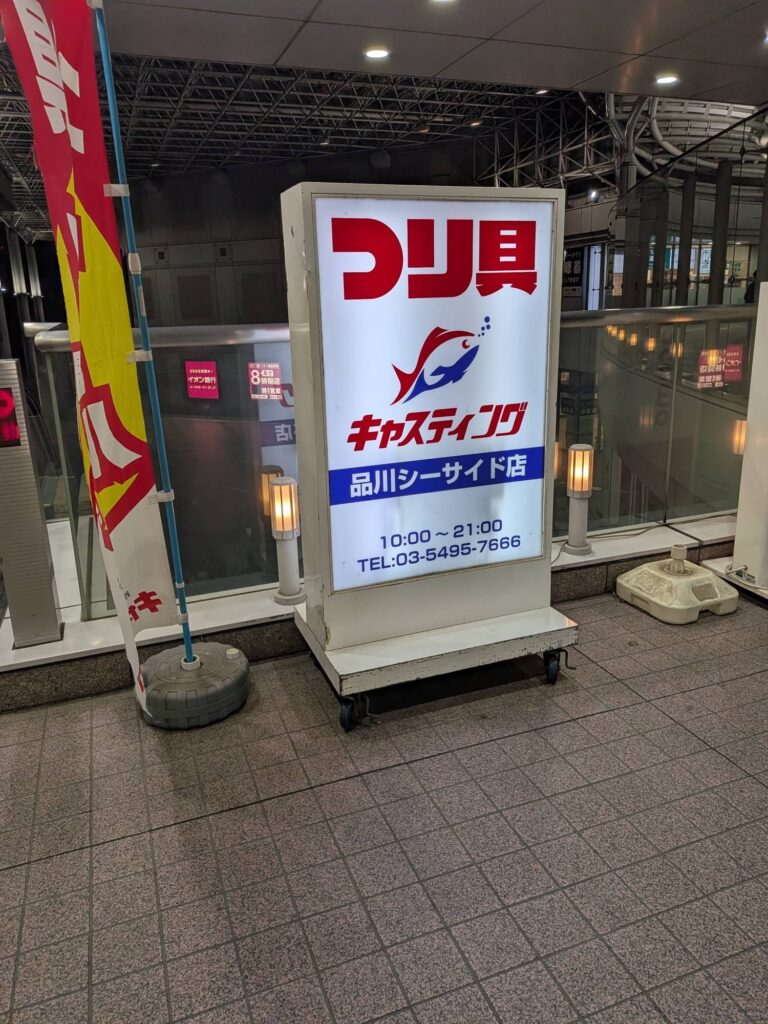
Casting (キャスティング) is one of the big tackle chains around Tokyo. The Shinagawa Seaside store sells everything for a day on the water: rods, reels, ready-made rigs (shikake), and both live and frozen bait.
| Store | Casting Shinagawa Seaside (キャスティング 品川シーサイド店) |
| Address | Shinagawa Seaside Park Tower 2F, 4-12-4 Higashi-Shinagawa, Shinagawa-ku, Tokyo |
| Nearest station | Shinagawa Seaside Station (Rinkai Line) |
| Hours | Mon–Sat and days before holidays 10:00–21:00 / Sun and holidays 10:00–20:00 |
| Closed | Open every day |
| Phone | 03-5495-7666 (Japanese) |
| Payment | Transit IC cards (Suica, PASMO), e-money and QR code payments accepted |
| Tax-free | Yes—bring your passport |
| Parking | Times car park in the building; 1 hour free if you spend ¥3,000 or more |
| English support | Not confirmed—I couldn’t check whether any staff speak English |
| Official page | https://castingnet.jp/shop/shop.php?s=21 |
What it was like: the staff were very polite and calm, and took the time to explain the nearby spots. Even if English is limited, telling them the fish and the place—“Honmoku de aji o tsuritai desu” (“I want to catch horse mackerel at Honmoku”)—is a good way to start. For more phrases, see How to Shop at a Japanese Tackle Shop.
The store also hands out free beginner leaflets on nearby fishing spots (in Japanese). The Honmoku and Daikoku details below come from those leaflets.
1. Oi Pier Central Seaside Park: Goby by Bike
The closest option is Oi Pier Central Seaside Park (大井ふ頭中央海浜公園) in Shinagawa, in the part called Nagisa no Mori (なぎさの森). It’s the kind of place you can ride to with a short rod and a cup of bait, and it’s known for goby (haze), the classic easy fish of Tokyo Bay.
- Where to fish: the park lists several rocky shores—Hazetsuki-iso (はぜつき磯), Midori-ga-hama (みどりが浜) and Shioji-iso (しおじ磯)—as places where people fish for goby. Yuyake Nagisa (夕やけなぎさ) itself is a shallow sandy beach.
- No fishing north of the fence at Yuyake Nagisa (the side toward the Nagisa no Mori office): it’s a protected tidal flat, and both entry and fishing are banned.
- By train: Oi Keibajo-mae Station (Tokyo Monorail), then about 8 minutes on foot. Buses also run from Shinagawa and Oimachi Stations to the “Yashio-minami” stop (6 minutes’ walk).
- By bike: it’s the spot the shop suggests for a quick, easy trip from Shinagawa Seaside.
- Season: goby are usually best in summer to early autumn.
- Gear: a short rod, a goby rig and lugworm bait—see Goby Fishing Gear for Beginners.
- Official site: https://tokyo-south-seaside-parks.com/oi-park/
If you want to try goby somewhere I’ve fished many times myself, see Edogawa Floodway Goby Fishing by Train.
2. Honmoku Fishing Pier: The Most Fish
Honmoku Umizuri Shisetsu (本牧海づり施設) in Yokohama is a long fishing pier built out into the sea. Of the spots in this guide, it has by far the widest range of fish and the most catches.
What you can catch: sabiki rigs (a string of small lure hooks) for horse mackerel, sardine and other small schooling fish; casting for Japanese whiting (kisu), flounder and seabass; float fishing for rockfish (mebaru), black sea bream and opaleye (mejina). You’ll also see scorpionfish (kasago), greenling (ainame), young yellowtail (inada), frigate mackerel and even Spanish mackerel (sawara) at times—and octopus can be caught all over the pier.
Where to fish: the area around the legs of the bridge-like walkway is a well-known good point, and the water there is about 20 m deep. Fishing straight down along the pier wall (hechi-zuri) is popular for rockfish.
| Fee (one visit) | Adults ¥900 / junior high ¥450 / elementary ¥300 |
| Multi-visit tickets (adult) | 5 visits ¥3,150 / 10 visits ¥5,400 / 20 visits ¥9,000 |
| Spectators | Adults ¥100 / children ¥50 |
| Hours | Apr–Oct 6:00–19:00 / Mar 6:00–18:00 / Nov–Feb 7:00–17:00 |
| By public transport | City bus route 26 from Yokohama or Sakuragicho Station (bound for “Umizuri Sanbashi” or “Yokohama Port Symbol Tower”), get off at Umizuri Sanbashi (海づり桟橋) |
| By car | Shuto Expressway Bayshore Route, Honmoku Futo exit, turn left and head to the end of D Pier. Large car park on site |
| Facilities | Office, rest area, shop, cafeteria and toilets |
| Phone | 045-623-6030 (Japanese) |
| Official site | https://yokohama-fishingpiers.jp/ |
Arrive Early: Why Public Transport Is Hard Here
Honmoku is popular, and I was told that you need to arrive around 5:00 a.m. to get a good spot, especially on weekends. That’s where public transport struggles.
- The bus is the bottleneck. The first route 26 bus to Umizuri Sanbashi leaves Sakuragicho Station at 6:02 on weekdays and 6:12 on Saturdays, Sundays and holidays (timetable checked November 2026). The ride takes about 26 minutes, so the earliest you can arrive is around 6:30–6:40.
- From March to October the gates open at 6:00, so by the time the first bus arrives, the best spots are usually taken. You can still fish—just expect a spot away from the popular areas.
- From November to February the pier opens at 7:00, so the first bus gets you there before opening. Winter is the easiest season to go without a car.
- Taxi: a taxi from Sakuragicho or Yokohama Station gets you there before the first bus. Expect to pay much more than the bus.
- Check the bus times on the day with a route planner such as Google Maps—timetables differ between weekdays, Saturdays and holidays, and they do change.
Rental Car: The Easiest Way to Be There at 5:00
If you want to be in line at 5:00, a rental car is the most practical choice.
- From Shinagawa Seaside, take the Shuto Expressway Bayshore Route to the Honmoku Futo exit, turn left and follow the road to the end of D Pier.
- There’s a large car park at the facility.
- Pick the car up the day before. Many rental counters don’t open until 8:00 or later, too late for a 5:00 arrival.
- You’ll need an International Driving Permit (or a Japanese licence) to rent a car.
Forgot Your Bait? You’ll Be Fine
You pay an entry fee at Honmoku, but the facility has almost everything on site: toilets, a cafeteria, and a shop selling rigs and bait. So even if you didn’t make it to a tackle shop the day before, you can buy what you need when you arrive.
3. Daikoku Fishing Park: Fenced and Family-Friendly
Daikoku Umizuri Koen (大黒海づり公園) is on Daikoku Pier in Yokohama, close to the Yokohama Bay Bridge. The whole pier is fenced, so it feels safe even with small children, and there’s a green park next to the office if anyone gets bored of fishing.
What you can catch: casting for flounder, Japanese whiting, white croaker (ishimochi) and seabass; sabiki rigs for horse mackerel, sardine and mackerel. Octopus, scorpionfish, filefish (kawahagi), greenling and rockfish are also caught here.
Where to fish: the leaflet recommends the first 20 m or so of the pier on the Bay Bridge side. The breakwater blocks (tetrapods) are off limits.
| Fee | High school and older ¥900 / junior high ¥450 / elementary ¥300 |
| Hours | Apr–Oct 6:00–19:00 / Mar 6:00–18:00 / Nov–Feb 7:00–17:00 |
| Closed | Maintenance days (call to check) |
| By car | About 3 minutes from the Daikoku exit on the Shuto Expressway Bayshore Route |
| Phone | 045-506-3539 (Japanese) |
| Official site | https://yokohama-fishingpiers.jp/ |
The leaflet only gives directions by car, and Daikoku is on an island of warehouses and expressways. If you don’t drive, Honmoku is the better choice.
4. Wakasu Seaside Park: Long Hours, Bring Your Own Bait
Wakasu Seaside Park (若洲海浜公園) in Koto, Tokyo, has a fishing breakwater plus a rocky shore and seawall, with views of the Tokyo Gate Bridge.
- Hours: you can use the breakwater 6:00–21:00 every day, except in bad weather. The rocky shore and seawall are free to use.
- What you can catch: goby, young seabass, scorpionfish, rockfish, black sea bream, anchovy, gizzard shad, halfbeak, white croaker, flounder and mullet.
- Rules: no casting (overhead or sidearm), including lures; no chum; up to 2 rods per person when crowded; no climbing onto the breakwater or over the fences.
- No tackle shop on site: the park’s shop closed in August 2025. Buy rigs and bait before you go—Casting Shinagawa Seaside is a good stop on the way. There’s a convenience store about 10 minutes’ walk away.
- By train and bus: Shin-Kiba Station (Rinkai Line, JR Keiyo Line, Yurakucho Line), then Toei bus Ki 11 (木11) to “Wakasu Camp-jo-mae”, about 15 minutes, then 5 minutes on foot. The Rinkai Line runs from Shinagawa Seaside to Shin-Kiba directly.
- Official site: https://www.tptc.co.jp/park/03_07
Which One Should You Choose?
- Just want to try fishing for an hour or two? Oi Pier Central Seaside Park for goby.
- Want the best chance of catching lots of different fish? Honmoku—by rental car if you want a good spot.
- Driving, with small kids? Daikoku—it’s fully fenced and has a park.
- Want to fish in the evening, or stay on one train line? Wakasu—open until 21:00, and Shin-Kiba is on the same Rinkai Line as Shinagawa Seaside.
Whichever you pick, stop by the shop first: tell the staff where you’re going, and they can match the rig and bait to the spot.
Before You Go
- Fees, hours and rules can change—check each official site or call before you go.
- Some areas are closed to fishing; follow the signs and staff at each spot.
- Take all your rubbish home, including line, hooks and bait packets.
- Don’t fish from dangerous places such as breakwater blocks.
FAQ
Do the staff at Casting Shinagawa Seaside speak English?
I couldn’t confirm it. The staff were very helpful, though, and showing the Japanese name of the fish and the spot works well.
Can I reach these spots without a car?
Oi Pier by bike or monorail, Honmoku and Wakasu by train and bus. Daikoku is much easier by car.
Can I get a good spot at Honmoku by bus?
On weekends it’s difficult. The first bus arrives around 6:30–6:40, while regulars line up from about 5:00. Go by rental car if a good spot matters, or visit from November to February when the pier opens at 7:00.
Do I need to buy bait before going to Honmoku?
No. The facility has a shop with rigs and bait, plus toilets and a cafeteria. At Wakasu, on the other hand, there’s no shop—bring everything with you.
About the author: Shohei is a Kanto-based angler who often fishes the Edogawa Floodway for goby.